- This topic has 25 replies, 2 voices, and was last updated 1 month, 3 weeks ago by
 CautiousInvestor.

- AuthorPosts
- 08 Sep '26 at 7:03 am #98806TrumanParticipant
The yen is outperforming again, partly due to data.
Real wage growth accelerated in July (2.4% y/y, 1.8% consensus, 1.6% prior).
Q2 GDP was revised up, but by less than expected (1.4% q/q SAAR, 1.1% prior, 1.8% consensus) and primarily due to a smaller contraction in business spending.The September BoJ meeting is fully priced for a 25bps hike and another hike is fully priced two meetings later by year-end.
 08 Sep '26 at 7:04 am #98807TrumanParticipant
German macro data is disappointing so far this week.
After industrial production fell 1.1% m/m in yesterday’s July reading (+0.2% consensus), exports fell by 0.8% m/m in this morning’s July print (+0.3% consensus). Imports fell by more (-5.7% m/m, -1% consensus) but after a large 4.5% prior gain
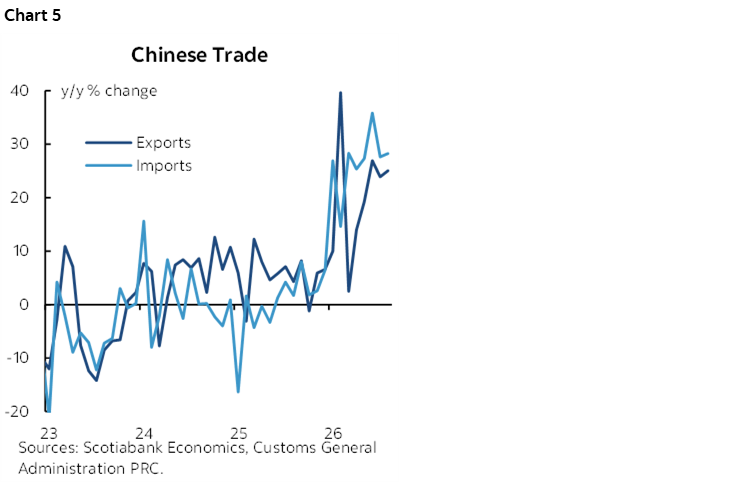
08 Sep '26 at 7:05 am #98808TrumanParticipantChina’s export growth picked up in August.
Exports were higher by 25% y/y (23.9% prior) in US$ terms and 18.6% in local currency terms (17.8% prior).
Imports also accelerated a touch with growth at 28.2% y/y (27.5% prior) in USD and 21.7% y/y in local currency terms (21.2% prior).
 08 Sep '26 at 7:50 am #98809TrumanParticipant
Rigetti, D-Wave Quantum, Quantinuum sign $100M deals with US gov’t to boost sector
Rigetti Computing (RGTI), D-Wave Quantum (QBTS), and Quantinuum (QNT) each signed deals with the U.S. Commerce Dept. worth $100M to boost quantum computing.
Rigetti’s deal is to help accelerate superconducting quantum R&D, and the funds come from the CHIPS Act, the Berkeley, Calif.-based company said in a statement. As terms of the deal, Rigetti will use the funds to pursue three projects to aid with easing bottlenecks in achieving utility-scale quantum computing: compressing readout electronics, expanding cryogenic capacity using a new cryostat architecture, and developing the capabilities for high-connectivity chip architectures.
“We are proud to be selected by the U.S. government to accelerate R&D and progress against our roadmap to deliver commercially viable quantum computing capabilities,” said Rigetti CEO Dr. Subodh Kulkarni in a statement. “Solving crucial challenges in scaling gives us the opportunity to transform the industry by putting large-scale quantum computers in the hands of America’s quantum computing researchers faster. Shortening the time to build quantum systems at scale and reducing their cost will also allow for broader adoption, which will strengthen our domestic quantum computing ecosystem.”
As part of the deal, the Commerce Dept. will receive a “minority, non-controlling” equity stake in Rigetti. The size of the stake could not be immediately learned.
D-Qave Quantum
D-Wave Quantum is also getting $100M from the Commerce Dept. as part of the CHIPS Act, with the money going towards advancing R&D for its superconducting annealing and gate-model technology development.“We’re grateful to the U.S. government for this award to D-Wave and for the leadership it is demonstrating in advancing quantum innovation,” said Dr. Alan Baratz, CEO of D-Wave. “The Administration has made clear that U.S. quantum leadership will require not only breakthrough research, but also the ability to scale, commercialize and manufacture these technologies. This award will help fulfill that mission by expanding domestic quantum capabilities, strengthening the underlying supply chain and bringing increasingly powerful quantum systems to market.”
As with Rigetti, the Commerce Dept. will also receive a “minority, non-controlling equity stake” in D-Wave as a condition for receiving the funds.
Quantinuum
Quantinuum’s funds, which also come from the CHIPS Act, will be used to support “critical R&D and U.S. quantum semiconductor manufacturing,” the company said in a statement.It is working with semiconductor foundry GlobalFoundries (GFS) to fabricate next-gen ion traps and control electronics. It’s also working with Monarch Quantum to develop and manufacture lasers and optical components.
Unlike Rigetti and D-Wave Quantum, the U.S. government will not receive a minority equity stake in Quantinuum, which was spun off from Honeywell (HON) earlier this year.
Rigetti shares rose 5.5% in premarket trading on Tuesday, while D-Wave and Quantinuum rose 2.1% and 1.7%, respectively.
08 Sep '26 at 8:23 am #98810TrumanParticipantThe US NFIB Small Business Optimism Index fell to 98.7 in August 2026 from 99.8 in July and below forecasts of 99.3.
Actual sales worsened, with a net negative 9% of owners reporting higher nominal sales in the past three months, the lowest since November 2025.
Reports of inflation as the single most important problem increased to 16%, now tying with taxes as the second top small business issue.
Reports of “labor quality or availability” and “labor costs” as owners’ single most important problem eased, with “labor costs” dropping to its lowest level since March 2021.
In addition, expectations for better business conditions deteriorated. “Uncertainty remains elevated among small business owners as they face a mixed set of challenges with weakened sales, supply chain disruptions, and inflation pressures.
While expectations for the overall economy dimmed, Main Street owners remain largely positive in the health of their own businesses”, said NFIB Chief Economist Bill Dunkelberg.source: National Federation of Independent Business
08 Sep '26 at 8:42 am #98811TrumanParticipantThe Manheim Used Vehicle Value Index fell 0.9% month-on-month in August 2026, marking a second consecutive monthly decline.
The index is a widely followed gauge of wholesale used-vehicle prices in the US.
On a yearly basis, price growth slowed to 0.4%, the weakest pace since December 2025, as resilience in EV and compact-car prices was offset by continued declines in pickups and SUVs.
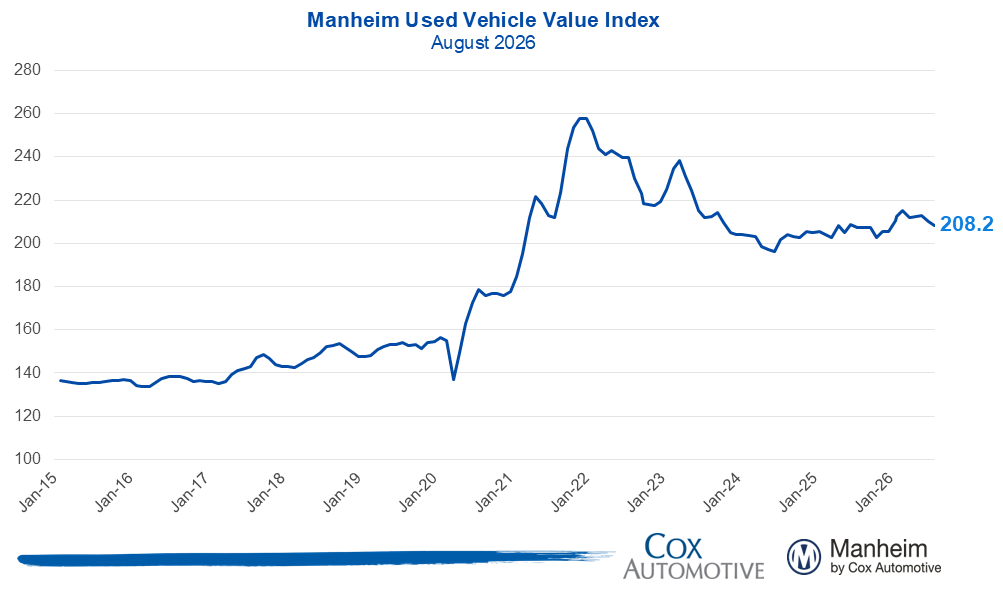
Cox Automotive Chief Economist Jeremy Robb said depreciation was stronger in July and early August before easing toward the end of the month. While younger vehicle cohorts saw greater depreciation, older and more affordable cars held up better, with nine- and 10-year-old vehicles remaining about six percentage points above their long-term averages, underscoring steady demand for affordable used cars.
Used retail sales continued to strengthen through August, while retail days’ supply fell to 44 days from 46 at the end of July. Stronger demand and tighter supply continued to support dealer purchases from Manheim. source: Manheim Consulting Inc.
08 Sep '26 at 8:50 am #98813TrumanParticipantGermany’s trade surplus largest trade surplus since August 2024
Widened to €21.3 billion in July 2026 from €15.4 billion in June v expectations of €16 billion
Exports fell less sharply than imports.Exports fell 0.8% month-on-month to €138.2 billion, compared with forecasts of no change, as sales to EU countries declined 1.6%, while shipments to third countries edged up 0.2%. Within third countries, the growth in exports was mainly driven by a 19.1% jump in exports to the US, while shipments to China and the UK fell 9.5% and 7.2%, respectively.
imports dropped 5.7% to €116.9 billion, with those from EU countries down 6.1% and from third countries falling 5.3%. Imports from China fell 7.5%
08 Sep '26 at 3:20 pm #98814CautiousInvestorKeymasterDow 52,786.07 -628.18 -1.18%
S&P 500 7,673.52 -45.08 -0.58%
Nasdaq 26,421.41 -85.58 -0.32%
VIX 15.72 1.19 8.19%
Gold 4,400.00 -76.6 -1.71%
Oil 94.25 2.77 3.03%09 Sep '26 at 11:14 am #98815TrumanParticipantUS sells 10-year notes at 4.834% vs 4.849% WI at $39 billion reopening sale
9 years, 11 months.
A very strong auction, and probably more important than the scary “highest 10-year borrowing cost since 2007” headline.
The clean read is:
4.834% stop vs 4.849% WI = 1.5 bp through
Bid to cover at 2.71 vs 2.53 prior
That is a clear improvement in demand.This should unwind some of the angst about Bessent’s buyback as it’s a 1.5 bps stop through, which is the most since April 2025.
In any case, this is still the most the Treasury has paid to borrow of 10 years since 2007.
That is a meaningful concession reversal and, as you note, the best stop-through since April 2025.
So despite all the noise around Bessent, long-end buybacks, deficits, oil at $100 and inflation risk, the actual primary market just said: there is real demand for duration at these yields.
The “highest yield since 2007” point is true, but almost beside the point tactically. High yield levels are precisely what can create the demand. What matters for today is whether buyers showed up relative to expectations, and they did.
That should take some heat out of the simplistic narrative that Treasury has to keep paying up because nobody wants the paper. The auction says the opposite: at 4.83%-ish, buyers were willing to come inside the when-issued level and take size.
And it fits the curve action we were already watching. If the front/belly is carrying more of the oil/inflation pressure while the long end keeps finding sponsorship, then today’s 10-year sale is another piece of evidence that shape matters more than the headline level.
The next tell is whether the secondary market holds the auction strength. If 10s can stay firm after the sale rather than immediately giving the stop-through back, that would be even more constructive for the Bessent/curve thesis.
09 Sep '26 at 2:11 pm #98816CautiousInvestorKeymasterDow 52,380.66 -405.41 -0.77%
S&P 500 7,636.36 -37.16 -0.48%
Nasdaq 26,253.34 -168.07 -0.64%
VIX 16.44 0.72 4.58%
Gold 4,444.00 5 0.11%
Oil 96.64 3.61 3.88%09 Sep '26 at 3:05 pm #98817TrumanParticipantEarlier US Treasury announced $6 billion buyback, less than expected
The Treasury floated out at ‘more than $4 billion’ buyback last month and today we get the actual numbers. It’s a $6 billion figure and that looks to be a disappointing one. Not only that it’s “up to $6 billion” so we have a limit.
There was talk of $10 billion, or even $12 billion.
The move will mean more T-bills and less long-dated Treasury supply in general, but not as much as feared. The 30-year is at a session high, up 3 bps to 5.29%.
10 Sep '26 at 6:41 am #98818TrumanParticipantAugust producer price index inflation ticks higher
y/y
US August PPI 5.4% v 5.3% expected
Prior 4.7% (revised to 4.8%)
Ex-food and energy 4.6% vs 4.6% expected
Prior ex-food and energy 4.2% (revised to 4.3%)
Ex-food, energy and trade +4.7% m/m vs +4.7% priorm/m
PPI final demand +0.4% v +0.4% expected Prior 0.0% (revised to +0.1%)
Ex-food and energy 0.2% vs 0.3% expected
Ex-food energy and trade +0.3% vs +0.4% priorDollar strength as a result.
Fed funds futures have ticked up to a 64% chance of a hike this month, though part of that is certainly an 8th day of oil gains.10 Sep '26 at 7:31 am #98819TrumanParticipantBoth WTI & Brent Breach USD/bbl
WTI 100.168 4.118 4.29%
Brent 105.392 4.182 4.13%
Gasoline continues higher
RBOB 3.3190 0.1084 3.38%10 Sep '26 at 1:10 pm #98820TrumanParticipant30-year Treasury auction draws strong demand as yields keep climbing
Thursday’s $22B auction of 30-year U.S. Treasury bonds (US30Y) multi-year high yields and mounting expectations of imminent Federal Reserve rate hikes.
The auction generated historically robust demand, with the new securities awarded at 5.308%—nearly three basis points below pre-auction trading levels. Because the bonds were priced lower than anticipated, aggressive bidders shut out investors holding out for higher yields.
WI level at the time of the auction 5.335%
Tail -2.7 basis points versus 013 basis points average
Bid to cover 2.61X versus average of 2.38X
DIrects (domestic buyers) 18.3% versus 22.1% average
Indirects (international buyers) 79.5% versus 66.4% average
Dealers (they get the rest) 2.2% versus 11.5% average.The big buyer was international at 79.5%.
Underscoring this fervent appetite, Wall Street primary dealers were left with a record-low 2.2% of the total sale, a key indicator that direct end-investors eagerly absorbed the supply.
This blockbuster auction unfolded against a broader surge in government debt yields, heavily influenced by spiking oil (USO) (BNO) prices that threaten to stall disinflation. Following the sale, the 30-year benchmark (US30Y) touched levels unseen since 2007 around 5.36%, while the two-year note (US2Y) (SHY) breached 4.5% for the first time since 2024. The 10-year tenor (US10Y) (IEF) also made a new multi-year high at 4.95%.
Consequently, traders are hastily recalibrating their monetary policy outlook. Markets now price in a roughly 70% probability of a Fed rate hike next week, fully anticipating a move by October. However, for long-term investors, the opportunity to lock in a risk-free 5.3% return for three decades clearly proved too attractive to pass up.
11 Sep '26 at 4:55 am #98822CautiousInvestorKeymasterDow 52,064.10 -316.56 -0.60%
S&P 500 7,591.70 -44.66 -0.58%
Nasdaq 26,081.72 -171.62 -0.65%
VIX 17.15 -0.69 -3.87%
Gold 4,387.10 -20.2 -0.46%
Oil 99.16 -3.32 -3.24% - AuthorPosts


- You must be logged in to reply to this topic.