The Bank of England MPC at its December meeting Thursday kept the key bank rate at 5.25% as expected in a 6–3 split vote. The bank left guidance on time spent at the peak unchanged, effectively leaving the door left equally open to another hike if needed. In that outlook recent jobs and inflation data were largely discounted by the BoE. There isa clear hesitation on whether declaring inflation being tamed quickly enough that they can soften language on the policy rate outlook. The market priced the first BoE rate cut will come at the June 2024 meeting, for a virtually unchanged at 115–120bps in cuts expected by end-2024.

The feeling in Britain is the situation seems to be out of control and the Central Bank prepared to damage Britain’s economy in the name of inflation. The moves have been devastating for the UK. mortgage holders. Retail sales recently registered their first positive quarter in 18 months, and consumer confidence had picked up.
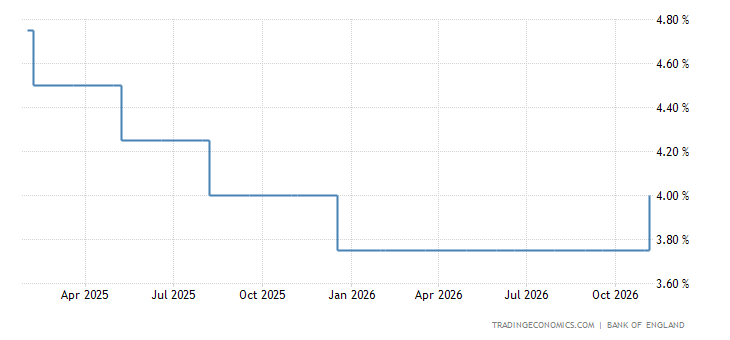
The core guidance sentence in the statement, “monetary policy is likely to need to be restrictive for an extended period of time”, was left unchanged.
Highlights
Bank of England announced December 2023, monetary policy decision.
- BOE keeps rates at 5.25%, per consensus
- Bank rate vote 3-6 as expected (Greene, Haskel, Mann voted to raise by 25 bps)
- The decision to hike or to hold was again “finely balanced”
- Still some way to go on inflation
- To take necessary decisions to get inflation all the way back to 2%
- Policy will need to be sufficiently restrictive for sufficiently long
- Most policymakers say it it too early to conclude that services inflation or pay growth are on a firmly downward path
- Further tightening in monetary policy would be required if there were evidence of more persistent inflationary pressures
- Sees inflation just under 4.5% by year-end (previously 4.75%)
BOE Governor Andrew Bailey Comments
- Bailey’s press conference highlighted that BoE MPC did not discuss rate cuts at this week’s meeting,
- Markets form their own view
- We are more cautious than markets
- We cannot say that interest rates have peaked
- It’s really too early to start speculating about rate cuts
- There is more to do on bringing inflation down to target
- But there are encouraging signs on inflation
Market Reaction (updated)
- GBPUSD s moved up from 1.2660 to 1.2705 and is eyeing the highs at the end of November and early December
- Wednesday’s Fed decision had already set in a 16bps increase in end-2024 rate cut expectations in the UK from pre-Fed level up to before today’s announcement.
- The combination of a still-hawkish vote split and the fact that the BoE did not give an inch to markets triggered a sharp 8bps rise in UK 2yr yields that has now normalized to about 4bps.
- Rates cuts pricing has been chopping around and initially had taken out 7bps in end-2024 expectations, but this move has now been erased to still see between 115 and 120bps in cumulative reduction by December 2024; the first-rate cut is still seen at the May meeting.
- The GBP added to its gains on the day to reach the 1.2725 level at writing on a 0.8% rally vs the USD,
- EURGBP fell 0.4% versus the EUR at 1.1645 after trading about 0.2% weaker in the lead-up to the statement.
Monetary Policy Summary, December 2023
The Bank of England’s Monetary Policy Committee (MPC) sets monetary policy to meet the 2% inflation target, and in a way that helps to sustain growth and employment. At its meeting ending on 13 December 2023, the MPC voted by a majority of 6–3 to maintain Bank Rate at 5.25%. Three members preferred to increase Bank Rate by 0.25 percentage points, to 5.5%.
In the MPC’s November Monetary Policy Report projections, conditioned on a market-implied path for Bank Rate that remained around 5¼% until 2024 Q3 and then declined gradually to 4¼% by the end of 2026, GDP was expected to be broadly flat in the first half of the forecast period, in part reflecting relatively weak potential supply, and an increasing degree of economic slack was expected to emerge from the start of next year. In the most likely, or modal, projection, CPI inflation returned to the 2% target by the end of 2025 and fell below the target thereafter. The Committee continued to judge that the risks to its modal inflation projection were skewed to the upside, such that the mean projection for CPI inflation was 2.2% and 1.9% at the two and three-year horizons.
Since the MPC’s previous meeting, advanced-economy government bond yields have fallen materially, including at shorter horizons, and risky asset prices have risen. Global GDP growth has been a little stronger than projected in the November Report. Consumer price inflation in the euro area and the United States has declined more quickly than expected. There remain upside risks to inflation given events in the Middle East, although oil and wholesale gas futures prices have fallen.
UK GDP was flat in 2023 Q3, in line with the November Report projection, and fell by 0.3% in October. Based on the latest official and survey data, Bank staff expect GDP growth to be broadly flat in Q4 and over coming quarters. The Committee continues to consider a wide range of data on developments in labour market activity. Employment growth is likely to have softened, and there has been further evidence of some loosening in the labour market.
Relative to the assumptions in the November Report, the fiscal measures in the Autumn Statement are provisionally estimated to increase the level of GDP by around ¼% over coming years. As these measures will probably also boost potential supply to some extent, the implications for the Committee’s output gap projection, and hence inflationary pressures in the economy, are likely to be smaller.
Annual private sector regular Average Weekly Earnings (AWE) growth declined to 7.3% in the three months to October, 0.5 percentage points below the November Report projection. That has brought AWE somewhat more into line with other indicators of pay growth, which have fallen below 7%. There remain upside risks to the outlook for wage growth, including from the possible effects of the recently announced increase in the National Living Wage.
Twelve-month CPI inflation fell sharply from 6.7% in September to 4.6% in October. Services price inflation declined to 6.6%, although much of the downside news relative to the November Report reflected movements in components that may not provide a good signal of underlying trends in services prices and of persistence in headline inflation.
CPI inflation is expected to remain near to its current rate around the turn of the year. In particular, services price inflation is projected to increase temporarily in January, related to base effects from unusually weak price movements at the start of this year, before starting to fall back gradually thereafter. The near-term path for CPI inflation is somewhat lower than projected in the November Report, in part reflecting recent declines in energy prices.
The MPC’s remit is clear that the inflation target applies at all times, reflecting the primacy of price stability in the UK monetary policy framework. The framework recognises that there will be occasions when inflation will depart from the target as a result of shocks and disturbances. Monetary policy will ensure that CPI inflation returns to the 2% target sustainably in the medium term.
Since the MPC’s previous decision, CPI inflation has fallen back broadly as expected, while there has been some downside news in private sector regular AWE growth. However, key indicators of UK inflation persistence remain elevated. As anticipated, tighter monetary policy is leading to a looser labour market and is weighing on activity in the real economy more generally. Given the significant increase in Bank Rate since the start of this tightening cycle, the current monetary policy stance is restrictive. At this meeting, the Committee voted to maintain Bank Rate at 5.25%.
The MPC will continue to monitor closely indications of persistent inflationary pressures and resilience in the economy as a whole, including a range of measures of the underlying tightness of labour market conditions, wage growth and services price inflation. Monetary policy will need to be sufficiently restrictive for sufficiently long to return inflation to the 2% target sustainably in the medium term, in line with the Committee’s remit. As illustrated by the November Monetary Policy Report projections, the Committee continues to judge that monetary policy is likely to need to be restrictive for an extended period of time. Further tightening in monetary policy would be required if there were evidence of more persistent inflationary pressures.
Source: Bank of England
From The TradersCommunity News Desk