Bank of Canada held its overnight rate to 5.00% in January 2023 as largely expected by markets, following up the no change from the previous meetings. The market was pricing in a 15% chance of a rate cut.
BOC said, “still concerned about risks to the outlook for inflation, particularly the persistence in underlying inflation” Of note the BOC statement no longer says it “remains prepared to raise the policy rate further if needed.” “Labour market conditions have eased, with job vacancies returning to near pre-pandemic levels and new jobs being created at a slower rate than population growth”.
The USDCAD was trading at 1.3570 ahead of the BoC decision and rose to 1.3580 afterwards but then fell because the Bank of Canada wasn’t dovish enough. The growth side of the equation now problematic, not inflation. Canada’s economy is in a recession, and it will only get worse as mortgage resets hit.

The BOC will hold a press conference at 10:30 am ET
BoC Highlights
- The overnight rate stays 5.00% Prior overnight rate was 5.00%
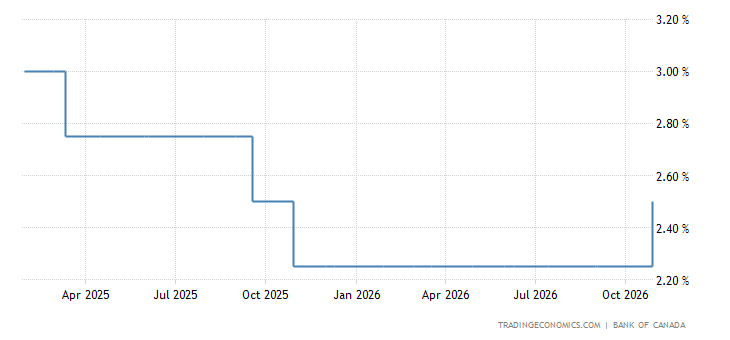
- Rates kept unchanged at 5.00%
- BOC “still concerned about risks to the outlook for inflation, particularly the persistence in underlying inflation”
- BOC statement no longer says it “remains prepared to raise the policy rate further if needed”
- The Canadian economy stalled since the middle of 2023 and growth will likely remain close to zero through the first quarter of 2024
- Economic growth is expected to strengthen gradually around the middle of 2024
- BOC forecasts GDP growth of 0.8% in 2024
- BOC expects inflation to remain close to 3% during the first half of this year before gradually easing, returning to the 2% target in 2025
- Core measures of inflation are not showing sustained decline
- Consumers have pulled back their spending in response to higher prices and interest rates
- Economy now looks to be operating in modest excess supply
- Labour market conditions have eased, with job vacancies returning to near pre-pandemic levels and new jobs being created at a slower rate than population growth
- Growth in the United States has been stronger than expected but is anticipated to slow in 2024
- Inflation rates in most advanced economies are expected to come down slowly, reaching central bank targets in 202
- Forecast for for 2.8% inflation this year is down from 3.0% in Oct
- There was a clear consensus to maintain our policy rate at 5%
- We are trying to balance the risks of over- and under-tightening
- We need to see further and sustained easing of core inflation
Bank of Canada economic forecasts
Inflation
- BOC expects inflation to remain close to 3% during the first half of this year before gradually easing, returning to the 2% target in 2025
- Core measures of inflation are not showing sustained decline
- Inflation rates in most advanced economies are expected to come down slowly, reaching central bank targets in 2024
- Forecast for 2.8% inflation this year is down from 3.0% in Oct
GDP and Jobs
- Economic growth is expected to strengthen gradually around the middle of 2024
- BOC forecasts GDP growth of 0.8% in 2024
- Labour market conditions have eased, with job vacancies returning to near pre-pandemic levels and new jobs being created at a slower rate than population growth
- Growth in the United States has been stronger than expected but is anticipated to slow in 2024
Press Conference: Release of the Monetary Policy Report / Publication du Rapport sur la politique monétaire
Sticky Inflation
Bank of Canada Full Rate Statement for December 2023
January 24, 2024
The Bank of Canada today held its target for the overnight rate at 5%, with the Bank Rate at 5¼% and the deposit rate at 5%. The Bank is continuing its policy of quantitative tightening.
Global economic growth continues to slow, with inflation easing gradually across most economies. While growth in the United States has been stronger than expected, it is anticipated to slow in 2024, with weakening consumer spending and business investment. In the euro area, the economy looks to be in a mild contraction. In China, low consumer confidence and policy uncertainty will likely restrain activity. Meanwhile, oil prices are about $10 per barrel lower than was assumed in the October Monetary Policy Report (MPR). Financial conditions have eased, largely reversing the tightening that occurred last autumn.
The Bank now forecasts global GDP growth of 2½% in 2024 and 2¾% in 2025, following 2023’s 3% pace. With softer growth this year, inflation rates in most advanced economies are expected to come down slowly, reaching central bank targets in 2025.
In Canada, the economy has stalled since the middle of 2023 and growth will likely remain close to zero through the first quarter of 2024. Consumers have pulled back their spending in response to higher prices and interest rates, and business investment has contracted. With weak growth, supply has caught up with demand and the economy now looks to be operating in modest excess supply. Labour market conditions have eased, with job vacancies returning to near pre-pandemic levels and new jobs being created at a slower rate than population growth. However, wages are still rising around 4% to 5%.
Economic growth is expected to strengthen gradually around the middle of 2024. In the second half of 2024, household spending will likely pick up and exports and business investment should get a boost from recovering foreign demand. Spending by governments contributes materially to growth through the year. Overall, the Bank forecasts GDP growth of 0.8% in 2024 and 2.4% in 2025, roughly unchanged from its October projection.
CPI inflation ended the year at 3.4%. Shelter costs remain the biggest contributor to above-target inflation. The Bank expects inflation to remain close to 3% during the first half of this year before gradually easing, returning to the 2% target in 2025. While the slowdown in demand is reducing price pressures in a broader number of CPI components and corporate pricing behaviour continues to normalize, core measures of inflation are not showing sustained declines.
Given the outlook, Governing Council decided to hold the policy rate at 5% and to continue to normalize the Bank’s balance sheet. The Council is still concerned about risks to the outlook for inflation, particularly the persistence in underlying inflation. Governing Council wants to see further and sustained easing in core inflation and continues to focus on the balance between demand and supply in the economy, inflation expectations, wage growth, and corporate pricing behaviour. The Bank remains resolute in its commitment to restoring price stability for Canadians.
Source: Bank of Canada Monetary Policy Report
From the TradersCommunity News Desk